
Faces of Midland: Amy Beasley & Kate Dornbos
Faces of Midland is a collaborative storytelling project celebrating the vibrant lives of those who live, work, and thrive in Midland.
Diversity beneath the surface
By Trisha Fenby
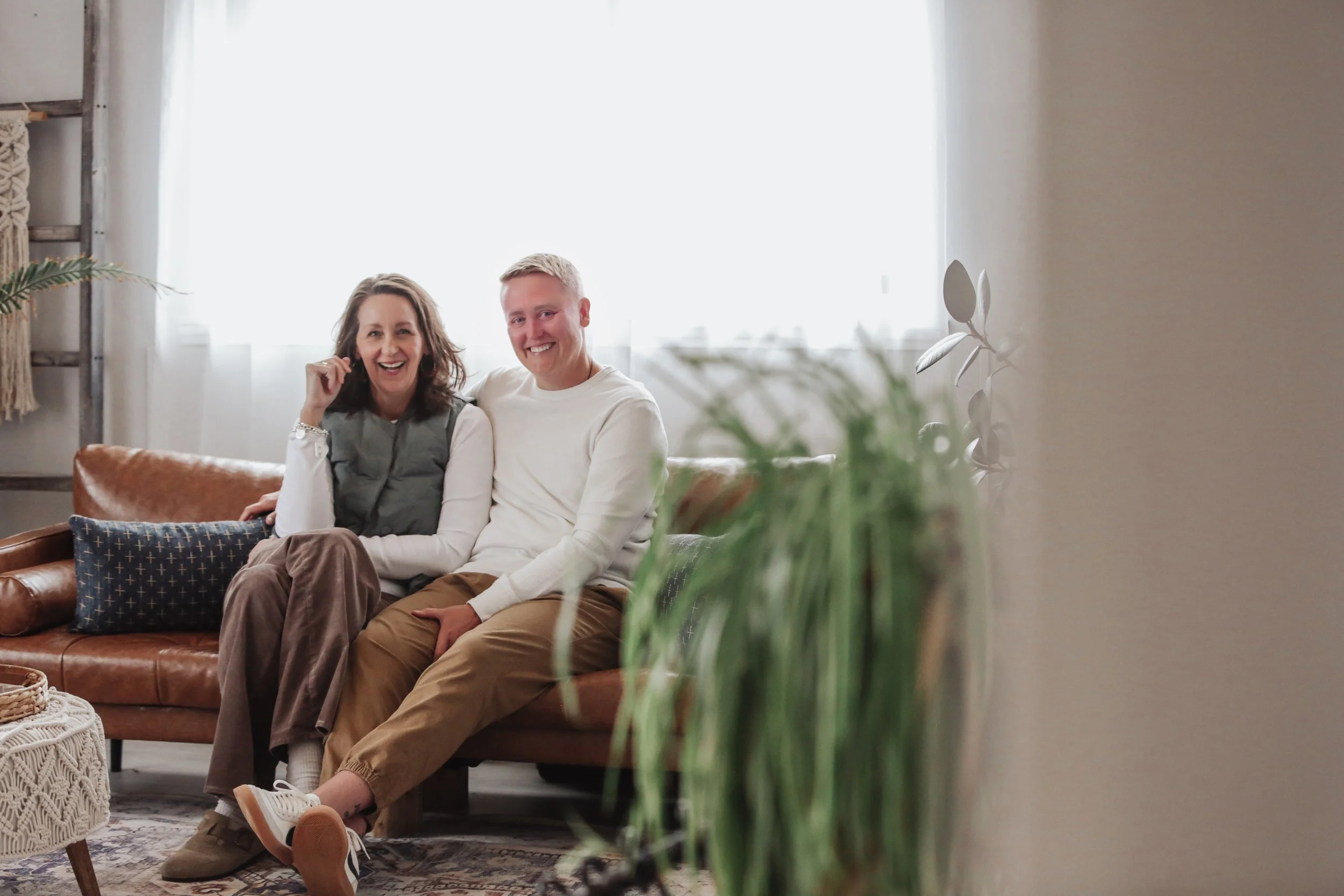
Photo by Renee’ Deckrow, Captured Studio
When you see Amy Beasley walk into the room. Her appearance alone conjures up an assumption that this successful, southern woman has followed a straight and narrow path. She seems to have it all. PhD in Environmental Toxicology and Molecular Genetics, a successful career, and a happy marriage. But what you see isn’t the whole story. She grew up in Montgomery, Alabama, when desegregation of schools was happening in real time and in an evangelical Christian community where her dad was a pastor. She recognized as a young adult that she is gay, but her parents’ reaction caused her to deny that identity and follow traditional expectations. Her first marriage ended tragically, and with two biracial children she remarried a church youth leader. Again acknowledging she was in an abusive marriage, she escaped and divorced, becoming a single mother of 4 and relying on public assistance for support while she went back to school. As an adult, Amy was diagnosed with ADHD and struggled with PTSD. Through all of this, one trait that is evident in Amy is her perseverance. Today, through that perseverance and hard work, In addition to the successful career, Amy is married to the love of her life.
Reflecting on her own experience, Amy offers a gentle challenge, "I wish more people were curious instead of judgmental. They miss all the richness of what people actually are, because they just stop at what they see.”
What we see is rarely the whole story. If we look a little deeper, we might learn something that changes our assumptions.
Amy’s wife Kate Dornbos experiences assumptions on a regular basis. While Amy’s story invites us to look a little deeper, Kate’s experience shows us what can happen when people don’t.
Kate presents in a masculine, non-conforming gender way. Her appearance directly shapes the way people treat her in public.
“Once I came out and I cut my hair short, I have been bullied, stalked and assaulted”, Kate shares, explaining why she is always observant and on “alert”.
Just using a public restroom has been a difficult task. Kate is approached constantly; being told she is in the wrong room. While the interaction itself is awkward, it forces Kate to plan.
She explains, “I refuse to go to the bathroom in Northwood University during basketball games, because every time I go in there, someone's says, ‘you're in the wrong bathroom’, sometimes, they’ll open the door, look at me, and leave”
Kate explained that she must be aware of her surroundings at all times. This heightened alert status is chronic, exhausting anxiety that she endures, just to do something as basic as using a public restroom.
Kate grew up in Vicksburg, Michigan, also in a Christian environment. Kate always knew that she is gay. She just didn’t really understand what that meant until she saw Ellen DeGeneres “come out” on national TV. That is when Kate had a word for all the feelings she experienced. She went to Hope College, where she wrestled with the conflict between her sexual orientation and her religious beliefs. A counselor was able to validate her being, “This is who you were made to be”.
That one defining moment with her counselor, someone that is willing to look beyond the surface and see the beautiful human inside, provided enough confidence for Kate to come out and live her truth. Approaching her family first, her mom and sisters were accepting but her dad was scared. The father-daughter relationship was strained for a few years but today they are extremely close. Throughout college and early career choices she was able to find her queer community.
A supportive environment validates belonging. Today, Kate is the Head Athletic Trainer at Northwood University, the first openly lesbian in the athletic department. While Northwood is a conservative college, the athletic department agrees the diversity in the staff provides a more accepting community on campus.
“When I think about what an ideal inclusive Midland looks like, I see something similar as to what I have experienced in the athletic department at Northwood.” Kate explains.
The kindness and respect that she has experienced extended beyond the stadium. Kate reflects on moments in her life that were difficult, her mom’s cancer diagnosis, the surgery that followed that diagnosis, and her mother’s passing. In each of these situations, her peers at Northwood extended grace, understanding and support. They provided the flexibility in her hours so she could be present for her mom. They brought food and helped care for Kate’s dog when she was away. They attended the funeral to show Kate that she had people in her life that cared.
In Kate’s experience, her community accepted support as a shared responsibility, strengthening their relationships with each other.
How we show up for others shapes our community. Being inclusive gives us the opportunity to notice, respond, and be present with others. We create a culture of value, respect and care.
Amy’s defining moment came a little later in life. Working with a counselor, she realized she’d been deeply dissociated for much of her life, existing in the body and the mind, but without connecting the two. In that moment, Amy was forced to see how long she had lived in performance mode, just trying to survive rather than as a whole, present person.
This became a turning point toward living life fully, reconnecting body and mind, feeling emotions, and grieving. Through this, Amy is learning to “be a villager”. Rather than always advocating for others, she is learning to let herself be vulnerable and supported in community.
After years in survival mode, Amy reflects, " I know how to be strong and advocate for anybody. The hard part is now allowing myself to be soft."
Kate and Amy met during Covid and became close friends through a shared love of creating community and belonging. Their union is nothing like they have experienced in past relationships. A quiet ceremony on the Capitol lawn in Lansing provided them with the legal protection they needed for hospital visits and insurance benefits. Later, they celebrated with friends in a joyful back yard gathering.
While marriage is a lot of work, neither Amy nor Kate feel the struggle they have felt in past marriages. There is no masking or performing, they show up fully as themselves.
Kate adds, “It’s been easy! We’re working toward the right things, in the same direction, and on the same team. It’s our #1 alliance.”
Kate and Amy know, from their own lived experience, that hiding is a form of self-protection. What they hope for is a community that chooses curiosity over judgement. Together, they are working to create spaces where people can feel safe and seen, to be exactly who they were meant to be.