
Prevention of Measles
As the spring travel season approaches, the local health departments serving Midland, Bay, and Saginaw counties wish to alert residents to the growing risk of measles in the USA. As of March 2026, >1,300 confirmed measles cases have occurred nationwide, with major outbreaks in popular travel destinations like Florida, South Carolina, and Utah. Michigan reported its first case of measles for the year on March 11, 2026. Reports of measles case counts and outbreaks are available from both the Centers for Disease Control and Prevention (CDC) and the Michigan Department of Health and Human Services (MDHHS).
Measles is highly contagious, spreads rapidly through the air, and can stay in the air for up to two hours after an infected person leaves the area. In crowded spaces like airports, planes, and theme parks, an unvaccinated person has a 90% chance of becoming infected if exposed. After becoming infected, unvaccinated travelers have commonly returned home and transmitted measles to other unvaccinated persons. Pockets of low vaccination allow measles to take hold and spread, and vaccination rates both statewide and in this region of Michigan remain well below the level required to prevent an outbreak (≥95%) if a case of measles were to occur in the community.
About one in five unvaccinated people who get measles will be hospitalized, and as many as three in 1,000 people with measles will die, even with the best care. Survivors can experience a variety of complications, including long-term immune system damage or immune amnesia.
Measles immunity is typically lifelong after natural infection or two doses of the measles vaccine (MMR), which also prevents mumps and rubella. The MMR vaccine is highly effective at preventing measles (93% effective with one dose and 97% effective with two doses). The MMR vaccine is very safe, and side effects are rare. For those with a history of previous measles infection, laboratory confirmation at the time of infection or a blood test (titer) measuring measles IgG antibodies documents immunity.
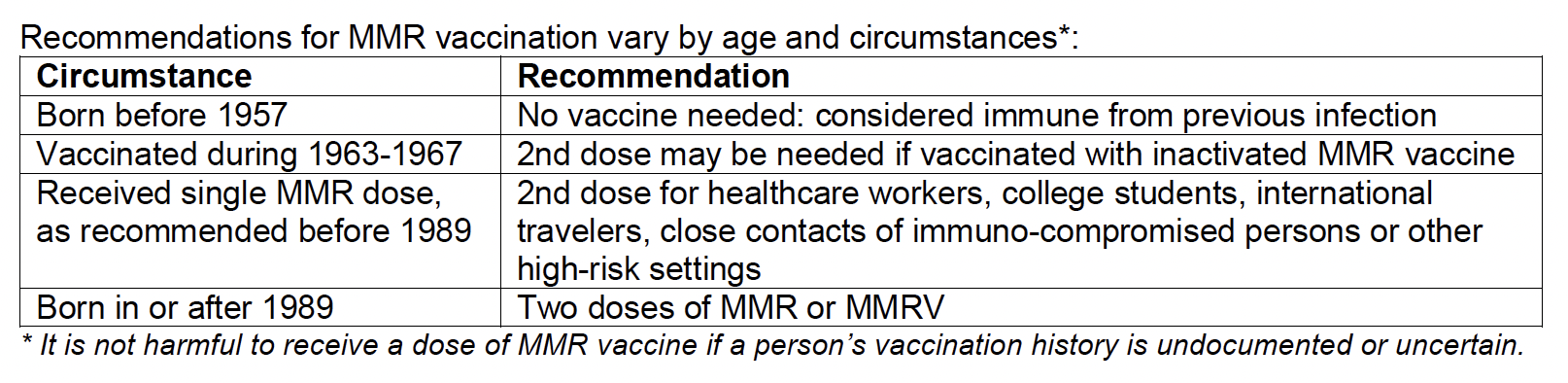
All residents are encouraged to check their immunization history and seek measles vaccination if needed. All local health departments, many local pharmacies, and some medical provider offices have the MMR vaccine on-hand.
Before any international travel or domestic travel to outbreak locations (e.g., South Carolina, Florida, Texas, and Utah) or destinations that attract international travelers (e.g., New York City, Washington, DC, Disney World, etc.):
Adults born before 1989 who received one MMR dose as children need one dose ≥2 weeks pre-travel.
Teens and adults without evidence of immunity need two doses (≥28 days apart) ≥2 weeks pre-travel.
Children aged ≥12 months need two MMR doses (≥28 days apart) ≥2 weeks pre-travel.
Infants aged 6–11 months need one MMR dose ≥2 weeks pre-travel. However, they will still need two more doses as part of the routine childhood vaccination schedule, at 12–15 months and at 4–6 years of age.
School exclusion in the event of a measles outbreak: Unvaccinated or incompletely vaccinated students and staff may be excluded from school, childcare, and other public/congregate settings for 21 days after the rash onset of the final case (this could take many weeks). Exclusion is a measure to prevent the spread of measles to those who are unable to receive the vaccine due to age or immune system conditions.
The “Three C’s” of measles – cough, coryza (runny nose), and conjunctivitis (red, watery eyes) – and a high fever precede onset of the characteristic rash, which appears 3–5 days after the beginning of the illness. The rash starts as small, flat, red spots (macules) on the face, behind the ears, and on the hairline and spreads rapidly downward across the body within 2–3 days, affecting the chest, back, arms, legs, and feet. The rash lasts from 4 to 7 days.
What to do after a measles exposure:
Even if you are immune to measles, whether from vaccination or previous documented measles infection, you should monitor yourself for symptoms for up to 21 days after a measles exposure.
If you are not immune and exposed to measles, you should monitor yourself for symptoms and stay home to prevent spreading the virus to others.
If you are experiencing symptoms that may be due to measles:
Stay home to prevent spreading the virus to others, even if immune.
Call ahead before visiting a medical facility to arrange testing in a way that minimizes exposure to others.
For more information, please review these resources:
Thank you for your attention to this important matter. If you have questions, you may contact your local health department in:
Midland County (989-832-6380; mcdph@co.midland.mi.us),
Health Officer, Fred Yanoski, MPH
Medical Director, Catherine Bodnar, MD, MPH
Bay County (989-895-4003; bchd@baycountymi.gov)
Health Officer, Joel R. Strasz, MPA
Medical Director, Thomas John Bender, MD, PhD
Saginaw County (989-758-3800; schd@saginawcounty.com)
Health Officer, Christina Harrington, MPH
Medical Director, Delicia Pruitt, MD, MPH
This article was shared from Midland County Department of Public Health.
Do you have a Midland County story you would like to tell that aligns with our vision?